The “Eye of Fusion” connects the physical state of fusion devices with operational control through diagnostic measurement. Systems are configured by device technology route, combining modules, data-processing software and engineering services to support measurement and analysis of key plasma parameters and feedback control.
Swipe horizontally to view all columns →
| Technology route | System description | Product stage |
|---|---|---|
| Tokamak | Electron-density interferometers and the terahertz laser polarimeter-interferometer (POINT) are central components, with diagnostic equipment configured for device requirements to support density feedback, current-profile reconstruction and instability analysis | Commercialized |
| Spherical tokamak | Optical paths, quasi-optical transmission and system layout are optimized for low-aspect-ratio, compact devices, enabling diagnostic integration within limited space | Commercialized |
| Field-reversed configuration (FRC) | Solid-state terahertz-source interferometry and a three-wave measurement architecture accommodate a wide density-variation range and short pulse durations | Commercialized |
| Stellarator | Established diagnostic technologies are adapted to three-dimensional magnetic configurations through optical-path design, data reconstruction and device-interface integration, advancing system integration, engineering verification and productization | Pre-industrialization diagnostic technology |
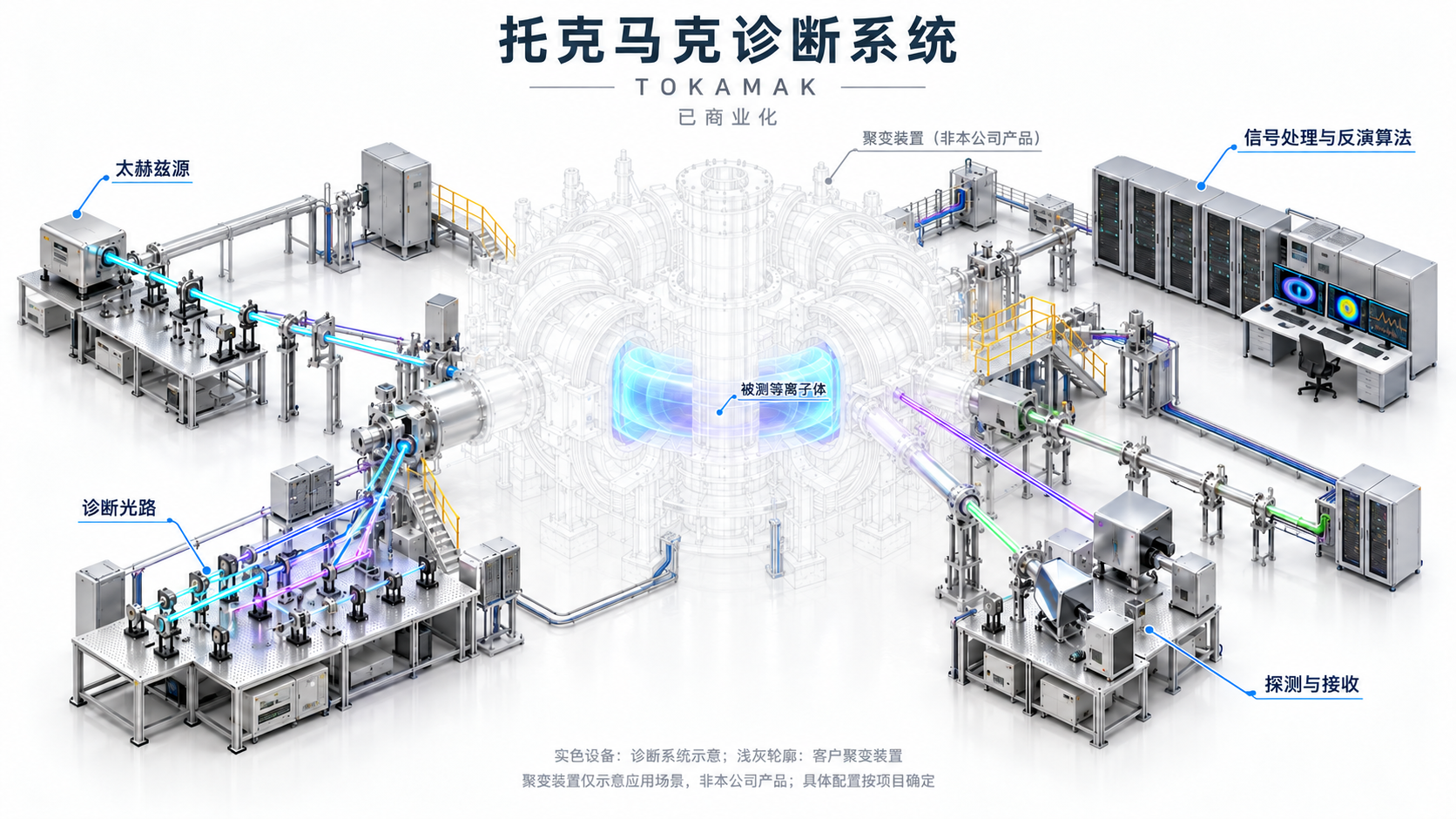
Tokamak diagnostics: electron-density interferometry and POINT polarimeter-interferometry support density feedback, current-profile reconstruction and instability analysis. The fusion device shown is the application environment, not a company-supplied fusion device.
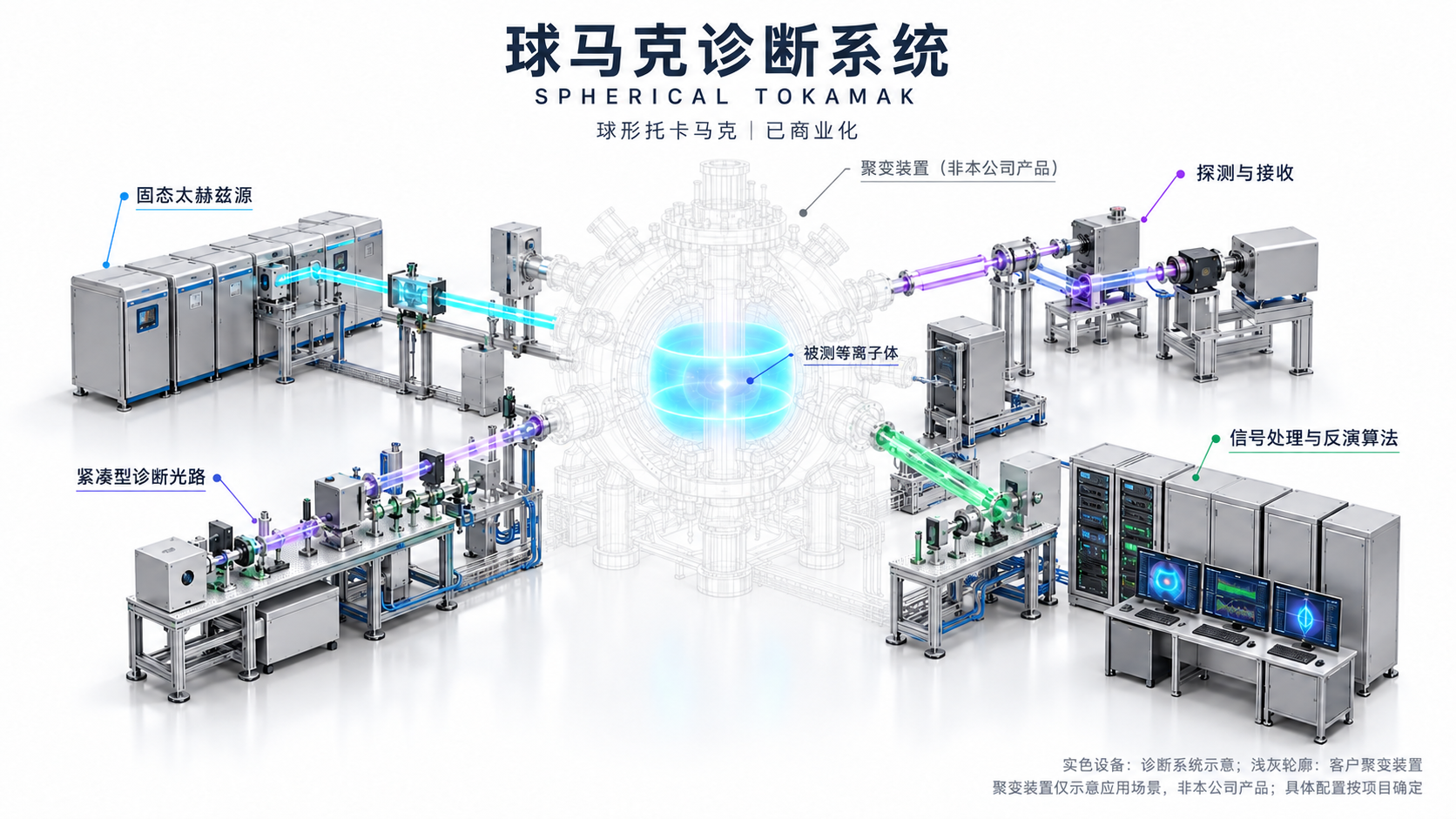
Spherical-tokamak diagnostics: optical paths, quasi-optical transmission and system layout are adapted to low-aspect-ratio, compact devices. The schematic is not a site photograph.
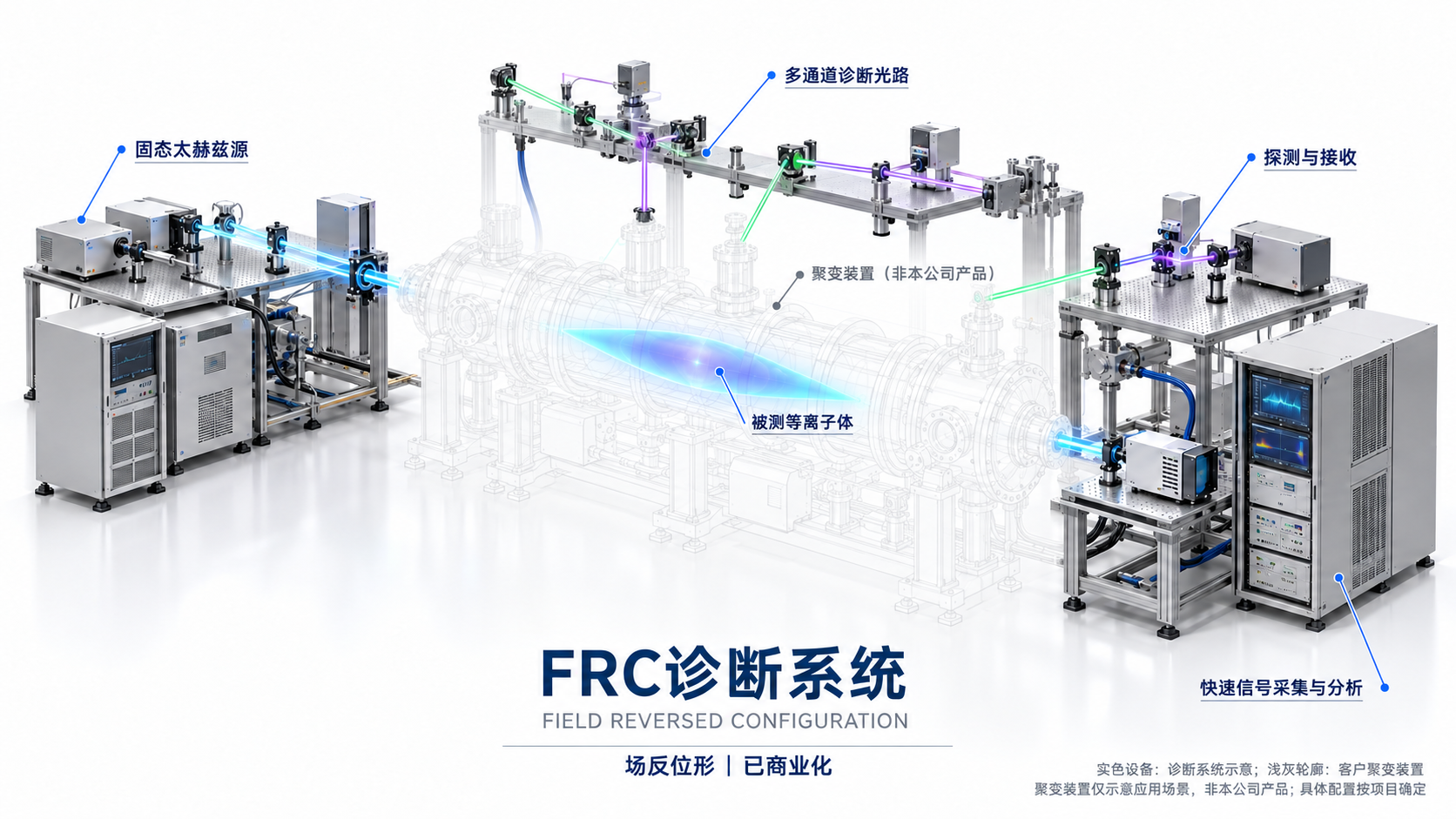
FRC diagnostics use solid-state terahertz-source interferometry and a three-wave measurement architecture for wide density ranges and short pulses. The fusion device is distinct from the diagnostic equipment.
Diagnostic equipment and software
Electron-density interferometers:
Two platform types, based on HCN terahertz lasers or solid-state terahertz sources, measure electron density in real time in fusion and other plasma-research devices.
Terahertz laser polarimeter-interferometer (POINT):
A three-wave architecture simultaneously measures line-integrated electron density and Faraday rotation angle. Software and algorithms support density-profile reconstruction and current-distribution analysis.
Data-processing and diagnostic-analysis software:
Connects data acquisition, signal processing, parameter calculation and result analysis, supporting diagnostic-parameter correction, system-state analysis and feedback-control data output.
Pre-industrialization diagnostic technologies
Building on established fusion-diagnostic principles and accumulated expertise, the company advances engineering and productization, focusing on device adaptation, system integration, testing and validation, and product finalization.
Swipe horizontally to view all columns →
| Technology direction | Diagnostic function | Engineering and productization priorities |
|---|---|---|
| Stellarator diagnostics | Plasma-parameter measurement in three-dimensional magnetic configurations | Diagnostic optical paths, device interfaces, data reconstruction, system integration and engineering verification |
| Collective Thomson scattering | Fast-ion velocity-distribution measurement for alpha-particle physics and fast-ion confinement research | Engineering integration, device adaptation and productization based on existing technical schemes and prototypes |
| Fast-ion loss detection | Fast-ion loss measurement through scintillator-signal detection and readout | Detector testing, readout and hardware/software integration, system commissioning and performance evaluation |
| Electron cyclotron emission, visible-light and neutron diagnostics | Measurement and analysis of different physical parameters and plasma behavior | Diagnostic configuration, engineering adaptation, verification and product finalization for specific device needs |
Pre-industrialization diagnostic research focuses on translating established diagnostic technologies into engineered products for specific devices. Current plans anticipate revenue from collective Thomson scattering and fast-ion loss detection systems during 2027; actual progress depends on engineering, productization and verification.
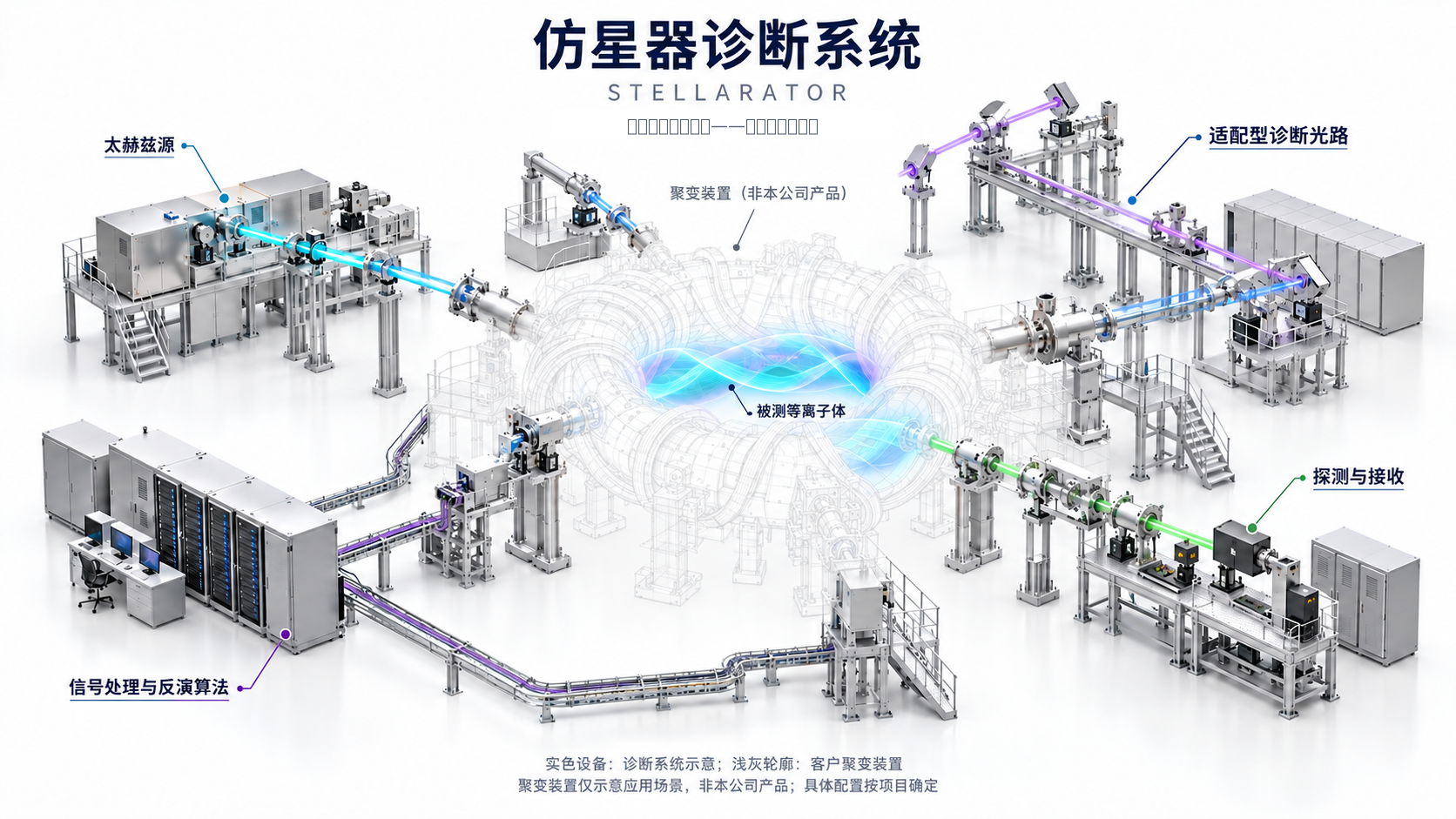
Stellarator diagnostics remain at the pre-industrialization stage. Engineering adaptation covers optical paths, data reconstruction and device interfaces for three-dimensional magnetic configurations; system integration, validation and productization are in progress.
System design and technical services
Services cover diagnostic-scheme design, equipment and module integration, on-site installation and commissioning, operation and maintenance, parameter testing and calibration, and data analysis across device design, engineering verification, operation and later upgrades. The core team's engineering experience on EAST, HL-3 and overseas devices supports system development and technical services. See Projects & Team Experience for details.