The company's technology draws on more than four decades of terahertz science and technology accumulated within the Chinese Academy of Sciences system, forming a complete independent technology chain in terahertz generation and detection, a foundation of fusion diagnostic technology.
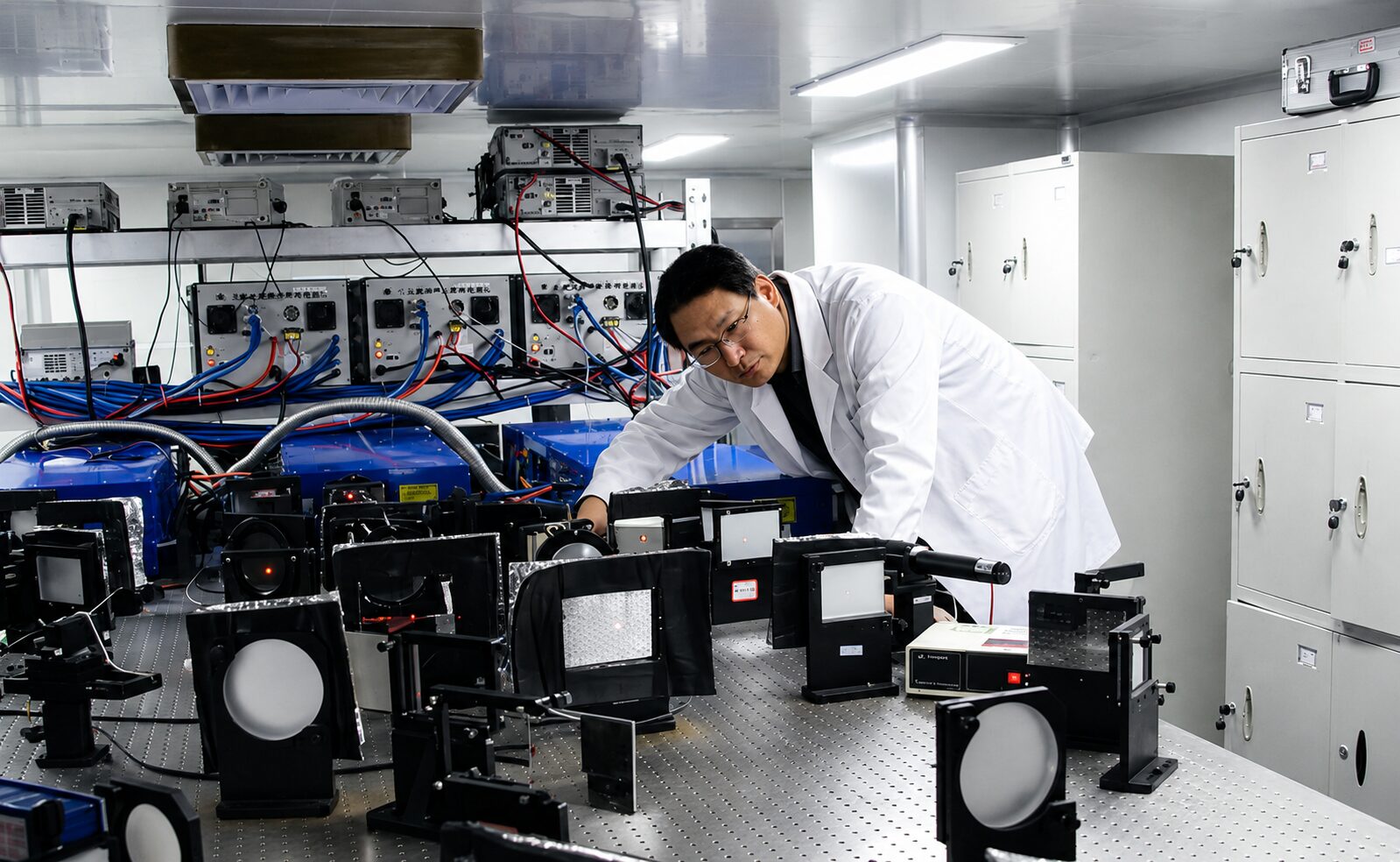
Optical laboratory work
Five technology directions
1. Integrated fusion diagnostic measurement and control
Diagnostic modules, data acquisition, signal processing, parameter reconstruction and device feedback-control interfaces are combined for plasma density, current-related parameters and other diagnostic needs. Existing measurement capabilities underpin continuing multi-parameter measurement and control-data coordination to support device-state analysis, commissioning and feedback control.
2. AI simulator development
For fusion-plasma modeling and diagnostic analysis, the company plans to combine measured diagnostic data, physical models and AI methods to develop parameter reconstruction, state prediction and operational-scenario assessment. Density, temperature and magnetic-field distribution are among the target parameters, supporting diagnostic-scheme design, system testing and device-operation research.
3. Fusion diagnostic verification and testing platform
Existing diagnostic testing and calibration capabilities support development of a standardized verification platform, integrating diagnostic calibration, optical alignment, integrated measurement and control, and vacuum-testing conditions. Measurement-data acquisition, performance comparison and system-adaptation validation provide a common testing baseline for pre-deployment scheme assessment and subsequent upgrades.
4. Terahertz application productization
Terahertz source, detection, imaging and software-algorithm capabilities developed for fusion diagnostics are translated into active personnel-screening instruments, industrial NDT and related products. Prototype development, application testing, software optimization, design finalization and production-process improvements enhance reliability, standardization and batch-delivery capabilities, advancing pilot applications toward productization.
5. Terahertz 6G communication modules
Research covers terahertz signal generation, reception and high-frequency circuit integration, advancing communication modules based on solid-state multiplier sources and heterodyne receivers for point-to-point high-speed transmission and satellite communications. Design and testing have been completed; subsequent commercialization is linked to communication-network and satellite deployment.
Collaborative R&D:
Long-term R&D collaboration with the Hefei Institutes of Physical Science, Chinese Academy of Sciences, and the University of Science and Technology of China covers technology development, commercialization of research outcomes and engineering verification. The core team continues to participate in international academic exchange.
Intellectual property:
The company develops IP in terahertz laser sources, detectors, solid-state multiplier sources, interferometric diagnostic systems and imaging algorithms. As of 15 September 2026, it held 67 granted patents, comprising 26 invention patents, 33 utility models and 8 designs, with another 17 patent applications pending, and 52 registered software copyrights. This IP spans core modules, system integration, software algorithms and product applications.